


Top Stories Daily Listen Now
RawStory
RawStory

All posts tagged "washington d c"

Two women were killed. MAGA's reactions lay bare its callous indifference to reality

Like everyone, I’ve been spending a lot of time thinking about Renee Nicole Good and the horrible fate that befell her in Minneapolis last Wednesday. Given what we’ve seen on video, that there is even debate over whether she deserved to die is absolutely unfathomable.

Facts:

  • Good was murdered (not merely “killed”) by ICE agent Jonathan Ross, in cold blood, at point blank range.
  • Ross purposefully stepped into the path of Good’s SUV and made sure he was (briefly) in harm’s way before firing the first shot as Good attempted to steer around him. The second and third shots were the results of pure fury.
  • Good was friendly and peaceful and in no way gunning to harm any ICE agent — as seen on Ross’s own cellphone recording.
  • By contrast, Ross was rageful and homicidal, seemingly hellbent on murdering Good for the crime of failing to follow a ludicrous order. Or because her wife was talking smack to him. Or both. His dismissing her — after blowing her away — as a “f------ bitch” speaks to a devastating lack of respect for human life.
  • Good was initially denied lifesaving medical aid.
  • Good was not a “domestic terrorist” but a woman who had just dropped her six-year-old child at school. The only terrorists were the ones she encountered, wearing masks and vests.

Almost equally terrifying were the immediate attacks on Good from Donald Trump, JD Vance, Kristi Noem, and others in positions of authority in the administration — before they knew a thing about her.

Good was reduced to a supposed subhuman, by people who dismissed her as a deserving victim in their ongoing assault on Blue America.

Furthermore, the FBI quickly announced that Minnesota state officials would not be permitted to participate in any investigation into Good’s death.

In layman’s terms, that’s called a cover-up.

Now let’s travel back to January 6, 2021, and a justifiable killing.

Ashli Babbitt was part of the mob that Trump provoked to storm the U.S. Capitol. A 35-year-old U.S. Air Force veteran, she was an increasingly radicalized adherent of the QAnon conspiracy theory, conditioned to believe the 2020 election had been stolen from Trump – because he said so.

Despite multiple warnings not to proceed, Babbitt attempted to climb through a shattered window beside a barricaded door to the House Speaker’s Lobby. At that point, she was shot in the shoulder, from inside the lobby, by U.S. Capitol Police (USCP) Lieutenant Michael Byrd.

After a USCP emergency response team administered aid, Babbitt was transported to Washington Hospital Center, where she died. Found to be carrying a pocketknife, she was the lone insurrectionist shot and killed by police.

USCP deemed the shooting “lawful and within department policy” and to have “potentially saved members of Congress and staff from serious injury and possible death.”

Almost immediately, Trump and MAGAworld seized on Babbitt’s killing as unnecessary, with Trump himself describing her, to Fox News, as “an innocent, wonderful, incredible woman.”

Unaddressed was the matter of Babbitt having attempted to smash her way into a government building with potentially murderous intent, as part of an angry mob looking to halt the certification of a presidential election.

Again: she was warned repeatedly to stop.

To those behind Trump’s Stop the Steal movement, none of this mattered at all. Babbitt was a perfect martyr for the cause, despite her death happening amid violent mayhem.

Trump jumped on the narrative that Babbitt was sacrificed for being a woman and it was up to him to protect women — which, given his professed penchant for grabbing women by the genitals, could not have been more ridiculous. Nonetheless, he insisted she died for lack of protection.

In April 2021, the U.S. Department of Justice under President Joe Biden announced following an investigation there was insufficient evidence to support a criminal prosecution of the officer who fired.

The key word here is “investigation.” A real one took place.

In early 2024, Babitt’s family filed a $30 million wrongful death lawsuit against the U.S. government. It went nowhere until last May, when the Trump administration reached an agreement to pay a $5 million settlement on the civil complaint.

Then, in August, the U.S. Air Force astonishingly confirmed it would confer full military funeral honors to Babbitt, a decision that inspired anger from those who still see the January 6 insurrection as a black eye on America’s soul.

Former Republican congressman Adam Kinzinger, a member of the House January 6 Committee and an Air Force veteran, called the decision “disgusting.”
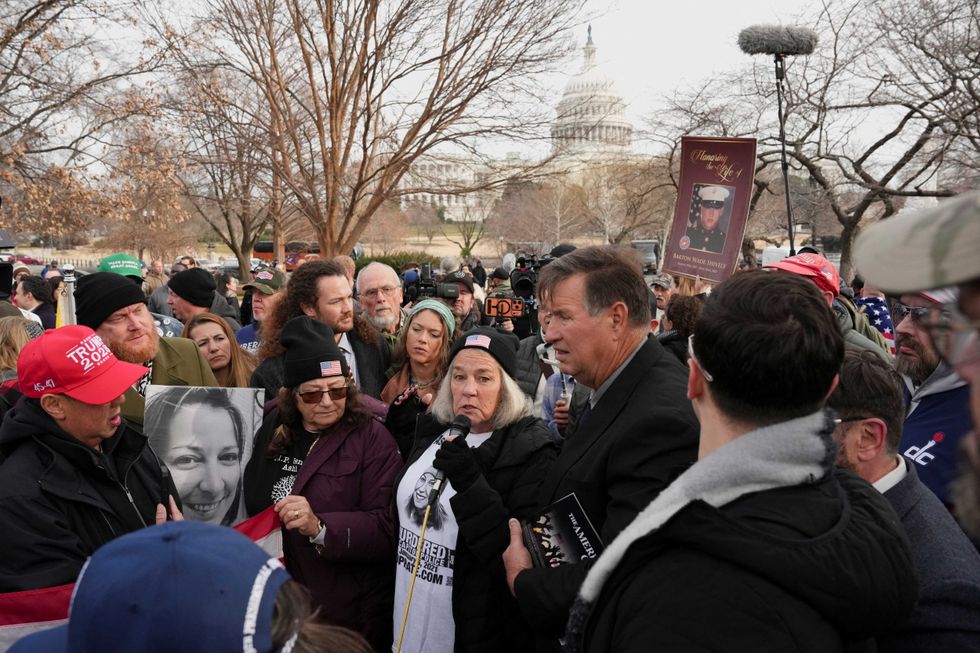
Micki Witthoeft, mother of Ashli Babbitt Micki Witthoeft, mother of Ashli Babbitt, speaks in Washington, D.C., last week. REUTERS/Leah Millis

So let’s compare and contrast.

Last week, in Minneapolis, a woman in her mid-30s looking to assist those targeted by ICE, who was otherwise minding her own business and looking to depart the scene once trouble started, had three bullets pumped into her face, was denied immediate medical aid, and in death was instantly denigrated and defamed as a liberal agitator who got what was coming.

Five years ago, in Washington, D.C., a woman in her mid-30s driven by conspiratorial, delusional mania was killed for, it seemed, looking to harm her perceived enemies. Her death was mourned by the same people who now vilify Good, and her family was enriched with millions of dollars and given the thanks of a grateful military, as if she were taken while defending the nation.

What’s wrong with this picture? Literally everything.

What’s the difference between Renee Nicole Good and Ashli Babbitt and the way those on the hideous right choose to view the groundless murder of one against the killing of the other while engaged in a criminal act?

Pure, unadulterated fascism, and a callous indifference to reality.

  • Ray Richmond is a longtime journalist/author and an adjunct professor at Chapman University in Orange, CA.
Trump's plan made these troops sitting ducks

Back in August, a publication written by and for US military members groused about the danger of National Guard troops performing lawn care in the nation’s capital.

Credibly ranked as having no political bias, The Military Times observed that the real threat to 2,300 troops deployed to D.C. wasn’t Trump’s imaginary “magnitude of violent crime” in war-torn domestic environs, but domestic assignments that rendered them sitting ducks.

Military analysts had warned for months that such deployments presented a “heightened threat environment” that was both wounding morale and risking the lives of enlisted soldiers. Uniformed troops gardening in the US capital also contradicted Defense Secretary Pete Hegseth’s focus on “lethality” and his “warfighting ethos.” After Hegseth announced that any activities that distract from lethality “shouldn’t be happening,” his rake-wielding fighters were mocked by foreign media outlets as “Trump’s lethal landscapers.”

Trump’s use of the military as Made-for-Fox News video props alarmed critics and supporters alike. Aside from sending troops into cities where they are not wanted, Trump’s politicization and purging of the military prompted a rare rebuke from former defense secretaries including Lloyd Austin and Trump’s own first defense secretary, Jim Mattis, who submitted a joint letter to Congress warning about Trump’s recklessness.

Military is legally and functionally different from law enforcement

For more than 150 years, for reasons easily traced back to the founding era, using military troops for domestic law enforcement has been illegal under the Posse Comitatus Act. Unless there’s an insurrection or rebellion, two specific words denoting specific conditions on the ground, a president cannot deploy the US military to enforce federal, state, or local law. The Insurrection Act, widely understood to be an exception to the Posse Comitatus Act, also requires specific conditions on the ground such as rebellion or an extreme level of violence necessitating military assistance.

Despite the clarity of federal law, Trump has sent military troops to US cities in the absence of rebellion, insurrection, or widespread rioting, using a revolving door of justifications from “quelling violence in Democratic-controlled cities” and “cracking down on crime” to “supporting deportation initiatives,” meaning, to help ICE, which is another form of domestic law enforcement.

Whatever excuse he trots out, Trump appears to be doing his level best to cause violent rioting in the streets so that there will be insurrection or rebellion. He’s counting on it, even though most Americans do not want cities occupied by troops.

The US military is not allowed to be used for law enforcement, because service members are trained to kill. The military’s primary mission is to defend the nation against foreign threats. Combat-ready military forces are trained to defeat adversaries through readiness and weapons training on lethality, resilience, and mission readiness in hostile environments, prioritizing skills like weapons proficiency, combat tactics, and survival. In obvious distinction, law enforcement officers exist and are trained to enforce domestic laws and protect civilian populations, which is best accomplished through de-escalation, proportionality, and the preservation of life.

Simply put, domestic law enforcement and the US military differ in terms of purpose, training, mission and goals, and it’s both disrespectful and dangerous to confuse them.

Attacking the truth

On Nov. 20, 2025, a federal judge ruled that Trump’s deployment of the military to the nation’s capital was illegal, and ordered an end to it. On Nov. 26, still deployed despite the court order, two members of the National Guard were tragically shot outside a D.C. Metro station while on foot patrol.

After one of the service members died, instead of offering introspection or comfort, Trump lashed out, doubled down, and blamed Joe Biden. Referring to the suspect's origins in Afghanistan, Trump told the press: There was no vetting or anything. They came in unvetted. And we have a lot of others in this country, we’re going to get 'em out.”

A reporter then pointed out that Trump’s own DOJ Inspector General confirmed the vetting, so why, exactly, was Trump was still blaming Biden? Trump exploded: “Because they let them in. Are you stupid? Are you a stupid person? Because they came in on a plane along with thousands of other people who shouldn’t be here, and you’re just asking questions because you’re a stupid person.”

Trump attacked the question because it didn’t fit his narrative: The shooter, Rahmanullah Lakanwal, was thoroughly vetted by both the CIA and the FBI because he previously worked with the CIA in Afghanistan, assisting in US combat missions.

Doubling down on lies won’t make us safe

Military advisers have long warned that putting American military members on city streets put them in increased danger. After the D.C. shooting, a member of the California National Guard texted the New York Times that he “knew that this would happen.” Having served six years in the Guard, the soldier said he and his commanders worried that the assignment “increased our risk of us shooting civilians or civilians taking shots at us.”

Instead of rethinking the obvious danger of putting military troops on US street corners, Trump has decided to double down by deploying 500 more troops to D.C., and stopping immigration entirely from poor nations. DHS announced further that, “The Trump administration is also reviewing all asylum cases approved under the Biden administration.”

Except, as Reuters pointed out, Lakanwal wasn’t granted asylum by Biden. He was granted asylum, this year, by the Trump administration.

  • Sabrina Haake is a columnist and 25+ year federal trial attorney specializing in 1st and 14th A defense. Her Substack, The Haake Take, is free.

Trump just ripped a page from the Stalin–Hitler–Mussolini playbook with grotesque move

Trump has ordered the U.S. Treasury to draft a $1 coin featuring him on both sides, for the purpose of “honoring America’s 250th Birthday and @POTUS,” according to Treasury officials.

Meanwhile, Trump wants the Washington Commanders NFL team to name their planned $3.7 billion stadium after him.

A senior White House source told ESPN: “It’s what the president wants, and it will probably happen.”

Presumably, Trump’s name will be carved into a granite facade at the stadium’s entrance.

The giant $300 million ballroom that Trump is adding to the White House is called “the President Donald J. Trump Ballroom” on the list of donors to the project, and senior administration officials say the name is likely to stick.

Trump is moving to immortalize himself with his name etched into coins, carved into pediments, and inscribed into White House marble. He wants to glorify himself in the most permanent ways possible.

This is what fascist dictators do when in power. Stalin, Hitler, and Mussolini built monuments to glorify themselves so they’d be exalted in history.

Democracies don’t do this. They memorialize their heroes only after they’ve died, and only if the public wants them commemorated.

Trump deserves to be remembered — but not as a hero. To the contrary: It is our solemn duty to ensure he is remembered for all that he has done and may still do to destroy American democracy.

He must be remembered as the president who claimed without evidence that an election was “stolen” from him. Who then instigated a coup that included false electors, threats to state officials, and an assault on the U.S. Capitol that resulted in five deaths and injuries to 174 police officers.

He should be remembered as the president who, after being reelected, tried to erase the nation’s memory of what he had done by pardoning 1,600 rioters who had been criminally convicted for participating in the Capitol attack and 77 people who had conspired with him to carry out the attempted coup.

He called them all “patriots.”

He must be remembered as the president who then usurped the powers of Congress. Who denied people due process of law. Who prosecuted his political opponents. Who violated international law by killing people he labeled enemy combatants. Who sent the military into American cities over the objections of their mayors and governors. And who openly and brazenly took bribes.

We must not allow Trump to erase this history with false tributes to himself, etched into silver, marble, or granite.

Instead, after he is gone, a monument should be erected to remind future generations of Trump’s treachery and the treachery of officials who supported him.

It would be a simple building constructed of iron and cement, containing the records of his attacks on democracy and the names of everyone who aided him.

Over its doorway would be the words “Trump’s Treason.”

It would be situated on the White House lawn where the Trump ballroom (since demolished) once stood. It would face Pennsylvania Avenue so that families visiting the nation’s capital — including those commemorating America’s 500th anniversary — have easy access, and will long remember this catastrophe.

  • Robert Reich is a professor of public policy at Berkeley and former secretary of labor. His writings can be found at https://robertreich.substack.com/.
  • Robert Reich's new memoir, Coming Up Short, can be found wherever you buy books. You can also support local bookstores nationally by ordering the book at bookshop.org.

'Warning shot': Sandwich guy and other grand jury refusals stir civil revolt against Trump

Grand juries are typically willing to “indict a ham sandwich,” a Republican judge famously said. But recently in Washington, D.C., in the case of a man who allegedly threw a sandwich at an immigration officer, a grand jury declined to indict.

That failed felony indictment and at least six similar cases signal a pattern of resistance to Donald Trump, experts said, citing opposition to what citizens see as overreach by an administration attempting to curb protest.

“The pattern of grand jury refusals indicates an emerging civil jury revolt against Trump-era federal prosecutions,” said Chad Cummings, who teaches law at Florida Gulf Coast University in Fort Myers, Fla.

“This suggests a coordinated resistance not from political actors, but from citizen-jurors who no longer trust the prosecutorial motives behind these charges.”

The wave of failed indictments is "astonishing” and “extremely rare,” said Harold Krent, professor at the Chicago-Kent College of Law at the Illinois Institute of Technology.

Other lawyers told Raw Story such actions are “exceptional” and “very unusual.”

In 2010, the latest year for which figures are available, only 11 times out of 162,000 did a grand jury not return a bill of indictment, noted Nora Demleitner, a former law professor and immediate past president at St. John’s College in Annapolis, Maryland.

To Krent, recent grand jury rejections “reflect the sort of skepticism of people drawn across some sections of the community to the charges brought by the Trump administration.

“They're skeptical about the wisdom or the strength of the cases that are brought in these. They sense an overreach.”

Citizen pushback likely won’t stop there, Krent said, adding: “I absolutely think it is a form of resistance.”

On Thursday, in a case that made it to trial, a Los Angeles protester was acquitted of misdemeanor assault charges brought by a Trump-appointed U.S. attorney over the alleged assault of a border patrol agent. Immigration officials were accused in court of lying about the incident.

‘Really scrupulous’

In D.C., the sandwich thrower was later charged with a misdemeanor. Less than a week later, a D.C. grand jury refused federal charges against a New York woman accused of threatening Trump.

Two days after that, D.C. U.S. Attorney Jeanine Pirro dropped federal felony charges against a man who allegedly threatened Trump. The man said he has disabilities and was intoxicated, according to WUSA9.

Discussing the case of the New York woman, Pirro claimed: “This is the essence of a politicized jury.”

She continued: “The system here is broken on many levels. Instead of the outrage that should be engendered by a specific threat to kill the president, the grand jury in D.C. refuses to even let the judicial process begin. Justice should not depend on politics."

Demleitner countered that jurors tend to be “really scrupulous,” adding: “They're really trying their hardest. They don't go in there with this idea of, ‘I'm not going to follow the law.’

“But then they see things differently and really struggle with that, so I think I would always want to assume goodwill on the part of a grand jury, especially because grand juries don't need unanimity.”

The prosecutor “runs the entire system” when it comes to grand juries, with no defense lawyer present, so grand juries “only hear one side” of any case, Demleitner said.

When grand juries refuse to indict, it can be because the prosecutor was unprepared, witnesses were doubted, or charges seemed overblown, Demleitner said.

“The problem is it's secretive, so we really don't know exactly what these grand juries are thinking,” Demleitner said.

“Some of them just seem to be cases that shouldn't have been charged, and I think there's a lot of people who say they wouldn't have been charged under a different administration.”

In early September, Pirro failed to get grand jury approval three times in a case related to an alleged assault of an FBI agent and an immigration officer.

“It should be a warning shot to the federal government to understand that they're not just going to go through with these cases and nobody will stand in their way,” Demleitner said.

‘A sword but also a shield’

Grand juries have long provided checks and balances on executive authority, Demleitner said.

“Pre-the creation of the United-States, the grand juries were actually really these amazing historical tools of rejecting, basically, the power of the king,” she said.

Turning back to the present, Demleitner pointed to other “no bill” decisions. Washington, D.C. grand juries have “rejected indictments in mandatory-sentence drug cases because they felt the sentences disproportionate to the offense.” Cases related to immigration protests in LA in 2018 also failed to produce indictments.

Jeanine Pirro U.S. Attorney Jeanine Pirro speaks during a press conference. REUTERS/Annabelle Gordon

Grand jury processes can be “really abused,” Demleitner said, such as when “grand juries did not indict members of the KKK when they lynched Black people, in the few cases where they seemingly went ever before a grand jury.

“It's not an unmitigated good for grand juries to do that, and the problem really is, we have no idea what the grand juries see and hear in the vast majority of cases, and so it's very hard to judge what actually went on in that room.”

To Cummings, recent grand jury refusals likely relate to jurors perceiving infringement on First Amendment free speech rights, the “holy grail of our civil liberties.

“It's not a Republican thing. It's not a Democrat thing. It's a free expression thing. It is a reluctance … to curtail those constitutionally protected civil liberties.”

Grand juries are “a sword but also a shield to protect private citizens like you and me from those overzealous, and I think in this case we can safely say politically motivated prosecutions,” Cummings said.

“Anytime we're applying felony charges to an expression of speech, that makes even lay people sit up and take attention.”

Krent said that as the Trump administration continues to clash with protesters and media over immigration enforcement, prosecutors can expect to see cases of jury nullification: when jurors return a not guilty verdict based on “their conscience,” even if they think the defendant broke the law.

“Jury nullification is the last protection a private citizen has against the overreach of the federal government,” Cummings said.

Nullification occurred under Prohibition, when jurors refused to convict defendants for alcohol-related offenses, and under slavery, when northern juries refused to convict escaped slaves and those who helped them, Krent said.

David Schwartz, an attorney who formerly worked in the grand jury bureau of the Brooklyn District Attorney’s Office, said jury nullification can be “concerning,” describing it as “disregarding the law and deciding the case the way you want to.”

“We're seeing in front of our eyes the politicization of our criminal justice system, and it's unfortunate,” Schwartz said.

Cummings argued that many federal cases under the Trump administration are themselves politicized, especially compared to the last Democratic administration, under Joe Biden.

“These people in the grand jury are smart enough to figure out, ‘Hey, this is political. We weren't seeing this before. We're seeing it now. Hmm, what's changed?’”

‘Irony is brutal’

While recent grand jury refusals have occurred in places that lean Democratic, Krent said, “the phenomenon could arise in red states as well.

“A cross-section of the citizenry are asked to look at the facts, look at the law, and determine whether there's a sufficient cause to bring charges. I think some will be skeptical.”

Trump’s rhetoric around “prosecutors are corrupt, the media is fake, and the justice system is rigged” is backfiring, Cummings said.

“Trump broke the public’s faith in institutional fairness, and now the system cannot even protect him.

“Enough people believed him that now, when he actually needs those systems to function impartially on his behalf, they will not. The irony is brutal.”

Trump's bizarre crime blitz is an absurd waste of time — here's clear proof

When Gov. Mike DeWine decided to send Ohio National Guard members to Washington D.C. to participate in President Donald Trump’s militarized crime crackdown, he took a national issue and made it a state issue. Why he decided to do so is perplexing.

Ohio’s violent crime rate has hovered between three and four times the violent crime rate of D.C. over the past four years. So the idea that resources should be sent from Ohio to Washington to quell violent urban crime is a strange one.

But even if DeWine were to deploy National Guard troops in Ohio to quell violent crime, is that the way to do it?

Research out of Brown University finds that military policing is not an effective tool for reducing crime rates.

At best, this sort of approach is a band-aid: long-term military occupation of cities is not a feasible strategy in a democratic country. At worst, it can be a distraction from solutions that actually could reduce crime rates.

So what actually could reduce crime rates in Ohio?

The evidence shows there are strategies that can be used to reduce violent crime.

One is a suite of strategies called “focused deterrence.”

Basically this approach amounts to identifying groups like gangs that are responsible for a large share of violence, calling them in and offering services if people leave the gangs, and delivering swift punishment if further violence takes place.

Meta-analysis of dozens of studies on these techniques show they are effective at reducing crime rates.

Another is “hot-spot policing,” a strategy that concentrates resources towards geographic areas where crime occurs most often.

Cost-benefit analysis by the Washington State Institute for Public Policy shows that deployment of one police officer in a hot spot leads to nearly half a million dollars in net social benefits realized in lower property crime rates.

This amounts to over $5 in social benefits for every $1 in costs.

A third strategy is more mundane but nonetheless effective: street lighting.

A randomized controlled trial that placed lighting in New York City housing developments found areas that received lighting saw reductions in index crimes, felony crimes and, to a lesser degree, assault, homicide, and weapons crimes when compared to places that did not receive them.

Similarly, restoration of vacant lots have been found to lead to reductions in overall crime, gun violence, burglaries, and nuisances.

Another promising program is targeted cognitive behavioral therapy.

Whether this is deployed with at-risk youth in conjunction with summer jobs programs or as a part of correctional programs, cognitive behavioral therapy has been shown to reduce propensity to commit crime among people who undergo it.

By giving people control over their own decision-making, they often opt not to take part in criminal activity.

These are just four approaches that are effective at reducing crime.

If the governor or federal lawmakers wish to make a dent on crime in major cities, deploying these strategies is the way to do it.

But I guess these would probably get fewer headlines than what they are doing now.

  • Rob Moore is the principal for Scioto Analysis, a public policy analysis firm based in Columbus. Moore has worked as an analyst in the public and nonprofit sectors and has analyzed diverse issue areas such as economic development, environment, education, and public health. He holds a Master of Public Policy from the University of California Berkeley’s Goldman School of Public Policy and a Bachelor of Arts in Philosophy from Denison University.

Jack Smith slams Trump's 'carnival' court request in new filing

Special Counsel Jack Smith slammed Donald Trump for attempts to turn his Washington D.C. election fraud trial into “a carnival” Monday with a new motion demanding proceedings not be televised, court records show.

Smith’s memo to U.S. District Judge Tanya Chutkan condemned Trump’s attorney’s requests to allow audio and video recording in the courtroom as just another attempt to campaign during the trial, arguing the former president would stop trying to delay proceedings if transparency was his primary goal.

“If the defendant sought sunlight as he claims, he should welcome the opportunity to put the Government to its proof at trial,” Smith wrote.

“Instead, his response to the applications shows that he will continue to attempt to avoid answering for his criminal conduct in the courtroom while at the same time publicly grandstanding on the Court’s docket.”

“Sunlight” is a direct reference to Trump’s attorneys’ Friday filings warning Smith wanted to prosecute a presidential candidate away from public scrutiny.

ALSO READ: Strong ammunition to obliterate the NRA agenda

"The prosecution wishes to continue this travesty in darkness,” the filing reads. ”President Trump calls for sunlight.”

Smith notes that it is common court practice to ban recording in high-profile federal cases. This shows Smith has precedent on his side, he argued, unlike Trump.

[Trump] does not cite a single rule or case in support of his position, because there are none," Smith writes.

"He desires instead to create a carnival atmosphere from which he hopes to profit by distracting, like many fraud defendants try to do, from the charges against him.”

As of Monday, it remains unclear when Chutkan will issue her decision on the matter.

'It's getting real': Judge Chutkan sets Trump jury selection three months from now

Start the countdown, Special Counsel Jack Smith can begin selecting jurors in his criminal election fraud case against former President Donald Trump in just three months, according to court records.

Judge Tanya Sue Chutkan on Thursday set Feb. 9 as the date when hundreds of potential jurors in Washington D.C. will receive copies of a questionnaire to determine their eligibility to take part in the federal case against Trump.

Responded one Politico reporter, in all caps, "It's getting real."

POLL: Should Trump be allowed to run for office?

The historic trial is slated to begin on March 4, 2024, the same year Trump hopes to reclaim the White House in a general election against Joe Biden.

Chutkan limited attorneys' ability to investigate potential jurors to openly accessible research databases and ordered them not to share any names with the public.

These limitations arrived as Smith raised concerns about Trump's history of using social media "as a weapon of intimidation in court proceedings," the Associated Press notes.

Trump stands accused of conspiring to overturn the 2020 election. It's one of four criminal court cases the top Republican candidate faces.

He denies the charges.

American Nazi Party registers a lobbyist in Washington D.C.

In a filing this week, the American Nazi Party registered one John Bowles as their official lobbyist in Washington, D.C.

Keep reading...Show less

Judge refuses to dismiss charges against anti-abortion protester

A federal judge this week refused to dismiss charges against an anti-abortion activist who allegedly tried to prevent a woman from entering a Planned Parenthood facility.

Keep reading...Show less